If you’ve ever downloaded a marathon training plan built around a specific finish time, you’re not alone. Goal times can be motivating, and they give you something concrete to aim at. The problem is that a goal time isn’t a training input. Your body doesn’t adapt to a number on a spreadsheet. It adapts to the stress you apply and the recovery you allow.
Right now I’ve got a number of athletes training for upcoming marathons, and there’s one pattern I see again and again: people don’t struggle because they “lack willpower”. They struggle because they’re trying to force a plan that’s written for a fitter version of them.
When we bring the plan back to current ability, things usually click into place: paces become realistic, recovery improves, consistency goes up, and the marathon-specific work lands properly.
If you’re unsure what pace you should be training at right now, use my Race & Training Pace Predictor as a sensible starting point.
My approach as a UESCA certified running coach is simple: start with your current ability, build durability and aerobic fitness progressively, and earn the right to add more specific work as you get closer to race day. That’s how you stay consistent, avoid the injury spiral, and actually give yourself the best chance of running well. (I’m also a UESCA certified ultra running coach, but the principles in this post apply directly to marathon training.)
The short version
Marathon pacing for beginners works best when it’s based on your current fitness, not an aspirational goal time. If your plan is too hard for your current ability, you’re more likely to miss sessions, accumulate fatigue, and get injured.
By current ability, I mean what you’ve actually been doing in the last 6–12 weeks, and how well you’re recovering from it.
A good running coach sets training paces and weekly load from your current fitness, then progresses them gradually so you can complete the full marathon training cycle.
The trap: picking a plan for a “future you”
Most goal-time plans assume you already have a certain base. That base might be:
- A consistent weekly mileage history
- A body that tolerates long runs without niggles
- Enough aerobic fitness to handle steady volume
- Enough resilience (strength, mobility, sleep, stress capacity) to recover between sessions
If you’ve had time off through injury (or you’re coming back after a niggle), start here first: How to Safely Return to Running After Injury
If you don’t have that foundation yet, the plan can push you into too much intensity, too much volume, or both. You might get through a few weeks on adrenaline, but eventually the bill comes due: missed sessions, constant fatigue, sore calves/Achilles, cranky hamstrings, or that familiar “I’m always on the edge” feeling.
Why current ability wins
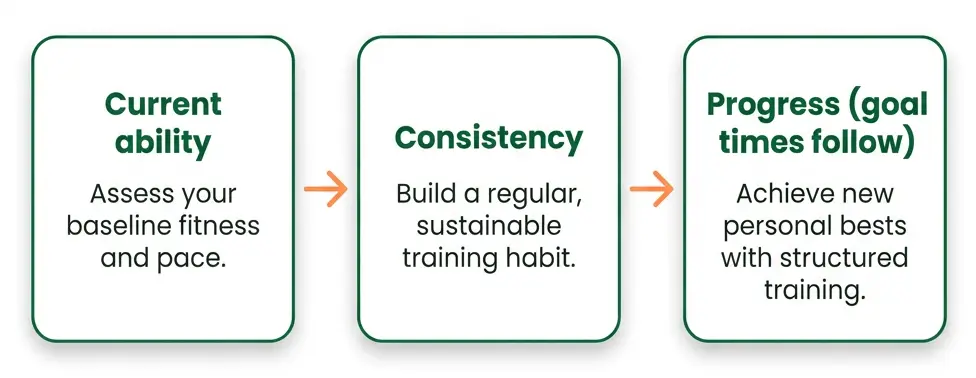
Good coaching leans heavily on individualisation, progressive overload, and managing total stress. In plain English: the best plan is the one you can absorb.
When your training matches your current ability:
- You can stack weeks without breaking down
- Your easy running stays truly easy (so you recover)
- Your quality sessions are high quality (not survival)
- You build aerobic capacity steadily (the engine for marathon training)
- You reduce big spikes in load (a common injury trigger).
If you like the more “numbers-based” side of this, I’ve written about one simple way to think about training load here: Acute:Chronic Workload Ratio (ACWR).
Consistency is the secret weapon. A runner who completes 90% of a sensible plan will almost always outperform a runner who completes 60% of an aggressive one.
What “current ability” actually means
This isn’t just about how fast you ran a 10K two years ago. Current ability is a mix of:
- Training history: what you’ve been doing in the last 6–12 weeks
- Durability: how well you handle long runs and back-to-back training days
- Recovery: sleep, stress, work schedule, life load
- Injury background: recurring niggles and past breakdown points
- Current fitness markers: recent races, time trials, or steady efforts
A good running coach will use this to set the right starting point, then progress you in a way that keeps you healthy.
Marathon pacing for beginners: set paces from fitness, not hope
Goal times still matter, but they should be guided by evidence. Instead of forcing paces because a plan says so, use your current fitness to set training zones and expectations.
Practical options include:
- Recent race results (5K/10K/half marathon)
- A controlled time trial (done sensibly)
- Steady aerobic efforts and how they feel week to week
One quick reassurance: it’s completely normal for the “right” training paces to feel too easy at first, especially if you’re used to chasing numbers. Easy running is where a lot of marathon fitness is built, and it’s what allows you to recover and keep progressing.
If you want a simple way to think about effort and pacing day to day, this will help: Effort Perception in Running.
Then you adjust as fitness improves. That’s not “backing off”. That’s coaching.
How to build toward a goal time without forcing it
Here’s a simple structure that works for real life and real runners.
1) Build the base first
Base doesn’t have to mean massive mileage. It means consistent, mostly easy running that you recover from well. The goal is to increase your capacity to train.
Key signs you’re ready to progress:
- Easy runs feel easier at the same pace (or same effort at a slightly quicker pace)
- Long runs don’t leave you wrecked for days
- Niggles are quiet and manageable
- You’re completing sessions without constant shuffling
2) Add quality gradually (and keep it purposeful)
For marathon training, quality should support the aerobic engine and marathon-specific stamina. That might include:
- Controlled tempo or threshold work
- Marathon-pace segments inside long runs
- Hills for strength and running economy
The mistake is adding too much intensity too early. You don’t need to “prove” fitness in February by running sessions you can’t recover from.
3) Make the plan flexible, not fragile
Rigid plans break when life happens. A better approach is to keep the key sessions (usually a long run and one quality session), then fill the rest with easy running that supports recovery.
If stress is high, you don’t “push through” to hit a pace target. You adjust the load so you can keep training next week.
A quick self-check: are you chasing the plan or building fitness?
Ask yourself:
- Am I completing most sessions, or constantly missing/adjusting because I’m cooked?
- Do I finish workouts feeling like I could do a little more, or like I’ve emptied the tank every time?
- Are my easy runs actually easy?
- Am I getting small, steady progress, or big swings between good and awful weeks?
If it’s the second option in each case, the plan is probably ahead of your current ability.
Where a running coach helps most
A good running coach doesn’t just write sessions. They manage the whole system:
- Progression that fits your history and injury risk
- Pacing guidance based on current fitness, not wishful thinking
- Adjustments when work, sleep, stress, or illness changes the picture
- Keeping you consistent long enough to actually peak on race day
That’s how you move from “I hope I can hold this pace” to “I’ve trained for this”.
If you’d like to talk it through, you can book a free consultation.
Key takeaways (summary)
- Marathon pacing for beginners should be based on current fitness, not a dream goal time.
- The best marathon training plan is the one you can recover from and repeat.
- Matching training to current ability improves consistency, reduces injury risk, and usually leads to better results.
- Use evidence (recent training and fitness) to set paces, then adjust as you improve.
Frequently asked questions
Can I still have a goal time for my marathon?
Yes. A goal time is useful for motivation and race strategy. The key is letting your current fitness guide the training paces and the weekly load, then adjusting as you improve.
How do I know if a marathon training plan is too hard for me?
Common signs include: persistent fatigue, repeated missed sessions, niggles that don’t settle, and workouts that feel like all-out efforts every week. If you’re constantly “chasing on”, the plan is probably ahead of your current ability.
What’s the biggest mistake with marathon pacing for beginners?
Starting too fast, too often. That can mean racing workouts, forcing marathon-pace runs before you’ve built the base, or setting training paces from a goal time you haven’t earned yet.
Do I need high mileage to run a marathon PB?
Not always. Many runners do well on moderate mileage when it’s consistent and supported by smart pacing, appropriate intensity, and good recovery. The right mileage is the amount you can absorb and repeat.
What does a running coach actually do differently from a generic plan?
A generic plan gives you sessions. Coaching gives you decision-making: realistic starting points, sensible progression, and adjustments when your body or life changes. That’s what keeps you training through the full cycle.
The bottom line
Chasing a goal time can be inspiring, but forcing training paces that don’t match your current ability is one of the quickest ways to stall progress. The best marathon training plan is the one you can recover from, repeat, and build on.
If you want a plan that matches your life and your current fitness, book a free consultation.